
Aligned Mind: Root to Crown
Complementary Resources.
Resources are provided to supplement the process of energy-informed psychotherapy and deepen connection with your own strength, intuition, and wisdom. This novel approach integrates evidence-based therapy psychotherapeutic techniques and symbolism/metaphors from ancient Vedic traditions.
How to Use These Resources.
Learning modules reflect my current experience and understanding of the energy systems. They are designed to supplement the process of therapy. Each module has three parts:
Introductory Video. Always start each topic by viewing the video. These videos provide a good overall sense of the topic. Click the button below each chakra section to watch.
Workbook. After you watch the introductory video, open the workbook PDF. The PDFs provide hands-on, experiential opportunities to connect more fully with each energy center or topic. A lot of the work happens between sessions. I am confident that if you lean in and do the work, you will experience the transformative clarity and insight that comes with this unique approach to therapy.
Additional Resources. These resources provide clarification for specific concepts and complementary practices.
The Chakra System
Our bodies are living matrixes of energy.
Energy as a Healing Force.
Many ancient models of wellbeing include the concept of a vital force or energy. Examples include: qi (chi) in Chinese medicine, ki in Japanese medicine, and prana in Ayurveda. Similar concepts are also found within Native American, Sufistic, and Kabbalistic traditions. More recently, Sigmund Freud used the word libido to describe his concept of a life energy force. And, psychologist, Wilhelm Reich, called it orgone energy and saw it as a healing force that can become trapped by behavior patterns, under the body’s armor.
Chakras in Modern American Culture.
Chakras (Sanskrit for wheels) were originally associated with gods, symbols, and mantras. When we look at ancient text, we see as few as four chakras and as many as 49 chakras. The concept of chakra system was introduced to American culture by the Theosophical Society in the 1870s. Chakras, which were originally conceptualized by advanced yogis as focused meditation points within the human body. were reimagined to include metaphysical constructs regarding the nature of consciousness and its interaction with mental, emotional, and physical systems (Jain et al, 2015). Over time, the chakra system evolved to represent the fusion of multiple schools of thought - including the work of psychologists Carl Jung & Abraham Maslow, mythologist Joseph Campbell, Western scholars of Indology, the Esalen Institute, energy healers, and a group of esotericists associated with the Theosophical Society. Over the last century, the seven charka system, with its rainbow of colors, has become much more accessible for regular folks; however, it is less connected to its roots.
Today, these concepts are most commonly found in the field of transpersonal psychology, a school of thought attributed to psychologist William James and reflected in the work of psychologist Carl Jung (both of whom embraced integration of Eastern influences within Western psychology).
Lifespan Development.
The chakra system has been reimagined to correlate with many Western theories of lifespan development, including Erickson’s Stages of Psychosocial Development and Piaget’s Stages of Cognitive Development.
In Vedic tradition, however, human development is conceptualized as unfolding within seven-year chakra cycles. The resources, here, include references to seven-year cycles and are loosely correlated with Maslow’s hierarchy of needs. However, these should not be considered “fixed”. Life rarely unfolds in a predictable, structured way. People tend to manage different developmental needs simultaneously, often influenced by personal experiences. These resources are offered as tools for exploring personal development and needs.
Using this model, seven chakras are conceptualized as positioned throughout the our bodies - from the base of our spine to the crown of our head. Each chakra has its own vibrational frequency, color, and governs specific functions.
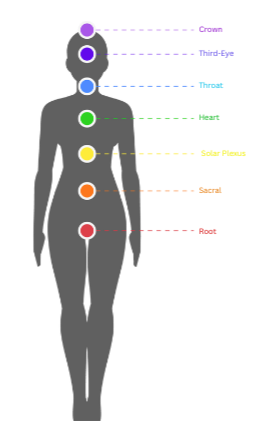
Crown | Sahasrara - spiritual connection, wisdom, bliss
Third Eye | Ajna - intuition, purpose, vision
Throat | Vishuddha - authentic communication, truth, self-expression
Heart | Anahata - connection, love, empathy, compassion
Solar Plexus | Manipura - confidence, self-esteem, personal power
Sacral | Swadhisthana - emotions, sexuality, creativity, joy, pleasure
Root | Muladhara - safety, security, trust, stability
-
![Root Chakra. Chakra-Informed Psychotherapy. The chakra system (rooted in ancient texts like the Vedas) offers a developmental and intergenerational roadmap of psychological and emotional growth that can powerfully support mental health and healing.]()
Root Chakra
-
![Sacral Chakra. Chakra-Informed Psychotherapy. The chakra system (rooted in ancient texts like the Vedas) offers a developmental and intergenerational roadmap of psychological and emotional growth that can powerfully support mental health and healing.]()
Sacral Chakra
-
![Solar Plexus Chakra. Chakra-Informed Psychotherapy. The chakra system (rooted in ancient texts like the Vedas) offers a developmental and intergenerational roadmap of psychological and emotional growth that can powerfully support mental health and he]()
Solar Plexus Chakra
-
![Heart Chakra. Chakra-Informed Psychotherapy. The chakra system (rooted in ancient texts like the Vedas) offers a developmental and intergenerational roadmap of psychological and emotional growth that can powerfully support mental health and healing.]()
Heart Chakra
Love and Compassion
Additional Resources.
Guided Heart Chakra Meditation (Video)
Somatic Exercises for the Heart Chakra (Video)
Heart-Brain Coherence (Video)
Conscious Grieving (Podcast)
-
![Throat Chakra. Chakra-Informed Psychotherapy. The chakra system (rooted in ancient texts like the Vedas) offers a developmental and intergenerational roadmap of psychological and emotional growth that can powerfully support mental health and healing.]()
Throat Chakra
Authentic Expression
Additional Resources.
Guided Throat Chakra Meditation (Video)
Somatic Exercises for the Throat Chakra (Video)
The Silent Child (Video)
-
![Third Eye Chakra. Chakra-Informed Psychotherapy. The chakra system (rooted in ancient texts like the Vedas) offers a developmental and intergenerational roadmap of psychological and emotional growth that can powerfully support mental health and heali]()
Third Eye Chakra
Intuition
Additional Resources
Guided Third Eye Chakra Meditation (Video)
Somatic Exercises for the Third Eye Chakra (Video)
Don’t Believe Everything You Think (Video)
Intuitive Healing (Video)
Where do our thoughts come from? (Video)
-
![Crown Chakra. Chakra-Informed Psychotherapy. The chakra system (rooted in ancient texts like the Vedas) offers a developmental and intergenerational roadmap of psychological and emotional growth that can powerfully support mental health and healing.]()
Crown Chakra
The Divine | Pure Consciousness
Additional Resources.
Guided Crown Chakra Meditation (Video)
Somatic Exercises for the Crown Chakra (Video
Living a Life of Surrender (Video)

Disclaimer: As with most philosophical frameworks, the scientific community offers little or inconsistent supporting material evidence. However, the interventions and therapy techniques, within this framework, are supported by consistent, measurable mental health outcomes in the scientific literature. These resources are complementary. You will NEVER be asked to participate in any topic or activity that is not directly align with your personal beliefsor goals.