
Holistic Support for Anxiety and Depression
Honoring the Intuitive Wisdom of Emotions
Understanding Your Emotions
Emotions are central to the life-regulating processes of almost all living creatures.
Clinical studies demonstrate that patients with brain lesions impacting emotional centers (i.e. the limbic system) are unable to make good decisions even when reasoning appears unaffected.
We wouldn’t have music, art, justice, or moral philosophy without the impelling force of emotions.
Our core emotions are necessary for survival and have specific wired-in program. They give us critical information about our environment and experiences.
Emotions are deeply connected to bonding. Think of the emotions you feel when holding a new-born baby in your arms or seeing a loved one again after a long absence.
Emotions like awe, gratitude, and compassion are powerful determinants of prosocial action. They can pull us out of ourselves and connect us with something larger than ourselves.
How long is the natural lifespan of an emotion? The answer is, it depends. The chemical process of an emotion lasts about 90 seconds. But, an emotion is more than a chemical process. We are complex beings with a well developed neocortex that seek resolution. Your brain may seek resolution by searching own data bank for patterns to create stories, deepen understanding, assign meaning, or identify ways to cope.
Researchers looked at 27 different emotions and found a wide degree of variability in terms of lifespan (Verduyn & Lavrijsen, 2015). Some emotions lasted for minutes and others lasted for hours. And some emotions seemed to pair up naturally but have different lifespans. Aa an example, fear was experienced for a brief period, but anxiety (its natural companion) lasted up to 24 hours for the participants in this study. Shame was also fairly short in duration (about 30 minutes), but guilt lasted up to 10 times longer.
Emotions that were associated with an event of high importance and rumination tended to last the longest. And, sadness, by far, was the longest lasting emotion with a lifespan of up to 5 days in this study. Let’s break this down a little more using a bereaved parent or partner as an example. Burying one’s child or partner is an event of high importance. It can upend the person’s entire life and challenge their beliefs, identity, hope for the future and so much more. Their brains will naturally ruminate and struggle to make sense of it. And for a lot longer than 5 days!
Anxiety

Anxiety isn’t just more common; it’s also much more complex. Current research suggests that 30% - 40% of people in the United States experience anxiety.
From political unrest and climate change to daily uncertainty and social instability, we are navigating a world that can feel overwhelming and beyond their control. Meaningful treatment requires more than surface-level strategies. It calls for a holistic approach that recognizes the interconnectedness of mind, body, nervous system, relationships, and environment.
Anxiety is a normal response to stress and it has an important job. It helps keep us safe. From an evolutionary perspective, anxiety is our body’s built in threat-detection system. Our brains evolved in a way that helps keep us alive by continuously scanning for potential danger. When your brain recognize a pattern or situation that it associates with danger, it sounds the alarm. This natural alarm system is designed to alert us to take action. Think of anxiety as analogous to your car’s brakes. If you are driving through an unprotected intersection, feeling anxious might help you slow down a little and avoid an accident. Our body’s natural alarm system is designed to alert us to danger so that we can take action.
Let’s consider the role that anxiety may play in your life. Visualize yourself as a neutral observer of your emotions and thoughts and see what comes up when you consider these questions.
How is anxiety influenced by your thoughts or past experiences?
What behaviors or outcomes is anxiety trying to manage?
What is anxiety protecting you from?
What truth, message, or story does anxiety tell if you listen with compassion and curiosity?
Anxiety is a normal and natural emotion. Everyone experiences anxiety at some point.
Anxiety can be experienced on a continuum from mild to extreme. Biology and experience can impact our natural threat system increasing hypersensitivity to perceived threats and wreaking havoc on our nervous system. Sometimes we get signals that something “bad” is about to happen when there is little or no threat to our immediate safety. If this happens a lot, it can become a problem and interfere with our quality of life. Think about a smoke detector that goes off every time you light small candle, turn on the oven, or for no discernable reason whatsoever. When this happens, worry and fear can become our constant companions. We may feel as if we are constantly on alert. If you are experiencing anxiety, there are some things that can help.
Holistic Strategies for Managing Anxiety
1. Re-train your brain with strategies aligned with the neurological pathway that your anxiety follows. Current research suggests that sensory information from our environment enters through our thalamus (our brain’s grand central station) and is routed to appropriate brain regions. For simplicity’s sake, let’s separate this complex, interconnected process into two possible pathways:
The CEO Pathway. Anxiety follows a route through our prefrontal cortex (thinking brain). In this case, strategies that focus on thoughts, reason, and logical thinking can be helpful.
The Caveman or Lizard Brain Pathway. The other pathway takes a more direct and involved route through our emotion center or limbic system. This pathway is ancient and automatic. Logic is often hijacked. Anxiety that takes this pathway responds better to direct experience and behavioral strategies.
Both are skills-based approaches designed to increase resilience rather than eliminate anxiety altogether.
2. Engage in activities that are linked to the release of oxytocin (the bonding or love hormone). Research suggests that moderate levels of anxiety may cause the release oxytocin. And we can engage in activities that honor and integrate the body’s natural healing response to anxiety. Some examples are petting animals, cuddling, hugging, skin-to-skin contact, mindfulness, massage, expressing affection, positive interactions with others, and eating. Interestingly some types of music and fragrances have also been linked to the release of oxytocin. Experiment a little and see what works best for you.
3. Exercise decreases stress hormones.
4. Limiting or eliminating alcohol, caffeine, and processed foods may help with mood fluctuations.
5. Meditation can help you manage anxiety. Consider meditations centered on love or your heart center.
6. Be mindful of the content you consume through social media and the news. This digital deluge can overload our cognitive systems. Our brains can struggle to process the constant drumbeat of emotionally charged information, leading to increases in anxiety and depression. After a while our brain’s “smoke detector” is going off all the time.
7. And, therapy can help you better understand the root causes, patterns, beliefs & behaviors, and somatic correlates that may contribute to your anxiety. You will also learn new strategies for managing anxiety in times of increased stress.
Depression

Sadness is not necessarily depression. Although uncomfortable, sadness is a core emotion that helps us remember what is important in life. It helps us slow down and think about our lives, relationships, and goals a little more introspectively. It is natural to go within when we are sad. Major life changes like death, break ups, and illness can bring feelings of sadness and remind us about what is most valuable in life.
Many of us have been taught to value and show only positive emotions. We learn to hide or mask emotions labeled as “negative” which may be seen as character flaws or mental weakness by others.
However, there are a couple things to consider before you allow yourself be talked out of your very real emotions:
Sadness is a universal human experience. There is no life without loss. And, are all living in a world where there is violence, injustice, despair, and scarcity.
Secondly, healing may be found in the emotions that we actively avoid or shun. Emotions, like sadness, or despair, carry a sacred wisdom that you cannot access if you are unwilling to travel the path of vulnerability with your emotional pain as your wise guide.
Acknowledging and allowing sadness can help us move toward acceptance and a more meaningful existence. It can actually help us create a more aligned version of our life. Gilbertson (2014), author of The Art of Constructive Wallowing, offers a focused practice of “being with your emotions” that includes intention, loving kindness, curiosity, and compassion. She suggests that if we truly want more joy and enthusiasm, it can be helpful to allow our real feelings (especially the uncomfortable emotions) to move through us, whatever they are. Let them tell their story and be open the messages and insights that they bring.
What would happen if we embrace and hold each emotion the same way we would hold a newborn (gently and with love)? Experiment with this a little. What happens when you hold sadness, anxiety, or anger close with respect and love?
Depression is more than sadness.
It’s a long-lasting shift in mood that affects how we feel, think, and function in daily life. Some of the common experiences of depression are:
feeling sad, empty, or hopeless most of the time,
low energy or feeling tired even after rest,
loss of interest in things you once enjoyed,
trouble sleeping, concentrating, or making decisions,
feeling worthless or guilty without a clear reason, and
thoughts of suicide.
We may feel like we are weighted down by a heavy, wet blanket and that the little things in life take a huge amount of effort to accomplish. We may want to isolate ourselves even though we feel lonely. And, we may question our capabilities, lovability, and worthiness.
Every person is different. Treating depression is generally a process that takes time and patience. With support and guidance, it is possible to regain a sense of joy and fulfillment in life.
Holistic Strategies for Managing Depression
1. Develop awareness of the cyclic impact of avoidant behaviors. Avoiding people, responsibilities, emotions, or meaningful activities may provide short-term relief but often reinforces isolation, inactivity, and hopelessness. Gradually approaching what has been avoided can build confidence, restore connection and pleasure, and create opportunities for positive experiences which interrupt the cycle that keeps depression going.
2. Engage in activities that reduce social isolation. You might be amazed at how much a brief social interaction (like chatting with someone in the grocery store line) impacts your mental health. Human connection is essential. Meaningful social connection and community support can reduce symptoms of depression.
3. Regular movement and gentle exercise release endorphins and serotonin which can help improve mood. Try taking a few little 10-15 minute walks every day. Or try yoga. Research also suggests that regular exercise may promote neuron growth and improve brain connectivity, similar to some antidepressants.
4. Practice Nervous System Regulation Strategies. Examples include
Grounding through the senses. Identify what you can see, hear, feel, smell, and taste.
Slow, gentle breathing. Try a slightly longer exhale than inhale without forcing deep breaths.
Rhythmic movement. Walk, sway, stretch, dance, or gently rock to support activation and regulation.
Morning light exposure. Spend time outdoors shortly after waking to support mood, energy, and sleep rhythms.
Temperature shifts. Splash cool water on your face or hold a warm drink to increase present-moment awareness.
Supportive touch. Place a hand over your heart or gently hold your arms while breathing naturally.
Vocalization. Hum, sing, chant, or read aloud to create soothing vibration and connection.
Co-regulation. Talk, walk, or sit quietly with a trusted person or pet.
5. Nutrition. Consider incorporating foods rich in Omega-3s, B Vitamins (B6, folate, B12), and Vitamin D. *Always consult your healthcare provider about about dietary or supplement changes.
6. This bears repeating. Be mindful of the content you consume through social media and the news. This digital deluge can overload our cognitive systems. Our brains can struggle to process the constant drumbeat of emotionally charged information, leading to increasing anxiety and depression.
7. Sleep. Getting enough sleep can help stabilize mood and increase energy.
8. Try some complementary approaches to help manage mood. This includes:
Creative expression through art, music, or writing.
Acupuncture or therapeutic massage.
Spiritual or contemplative practices. Meditation is so good for your brain! Researcher and author, Andrew Newberg, suggests that just 13 minutes of meditation each day can improve cognitive and emotional health by strengthening neural circuits for focus, reducing cortisol (a stress hormone), and increasing compassion.
Energy-informed practices, such as EFT (tapping)
Self-compassion and gratitude practices.
Connect with nature. Notice the breeze, sunlight, trees, water, or birds for a few minutes.
9. Therapy can help you better understand patterns of thinking and behavior that may contribute to depression.
Book Nook
-
![Book cover titled "Thich Nhat Hanh - Peace is Every Step: The Path of Mindfulness in Everyday Life" with a yellow flower illustration at the top and green leaf illustration at the bottom.]()
Peace is Every Step
Everyday Mindfulness
-
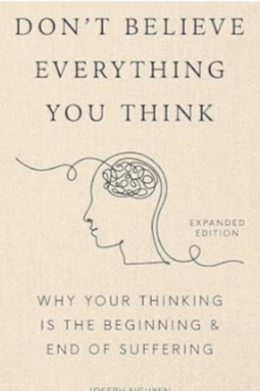
![Book cover titled 'Don't Believe Everything You Think' with a simple outline illustration of a person's head and brain, and text indicating it is an expanded edition discussing how thinking influences suffering.]()
Don't Believe Everything You Think
Understanding the impact and origin of you thinking patterns
-
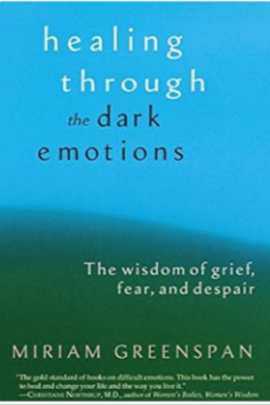
![Book cover with title 'Healing Through the Dark Emotions' by Miram Greenspan, featuring a blue gradient background.]()
Healing Through the Dark Emotions
The wisdom of grief, fear, and despair
-
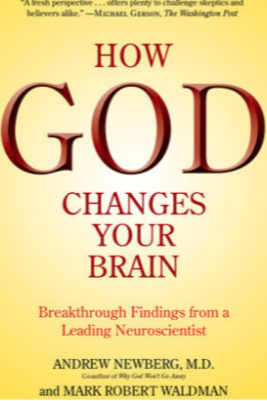
![Book cover titled 'How God Changes Your Brain,' with the subtitle 'Breakthrough Findings from a Leading Neuroscientist,' authored by Andrew Newberg, M.D., with Mark Robert Waldman.]()
How God Changes Your Brain
Meditation and prayer as practices to promote cognitive and emotional health